Wonderful Star, Mira.
놀라운 별, 미라.
Large images:
https://cometsky.com/astrophotos/mira_20260120_med_kor_bsyeom.jpg
https://cometsky.com/astrophotos/mira_20260120_med_kor_ex_bsyeom.jpg
https://cometsky.com/astrophotos/mira_20260120_med_en_bsyeom.jpg
https://cometsky.com/astrophotos/mira_20260120_med_en_ex_bsyeom.jpg
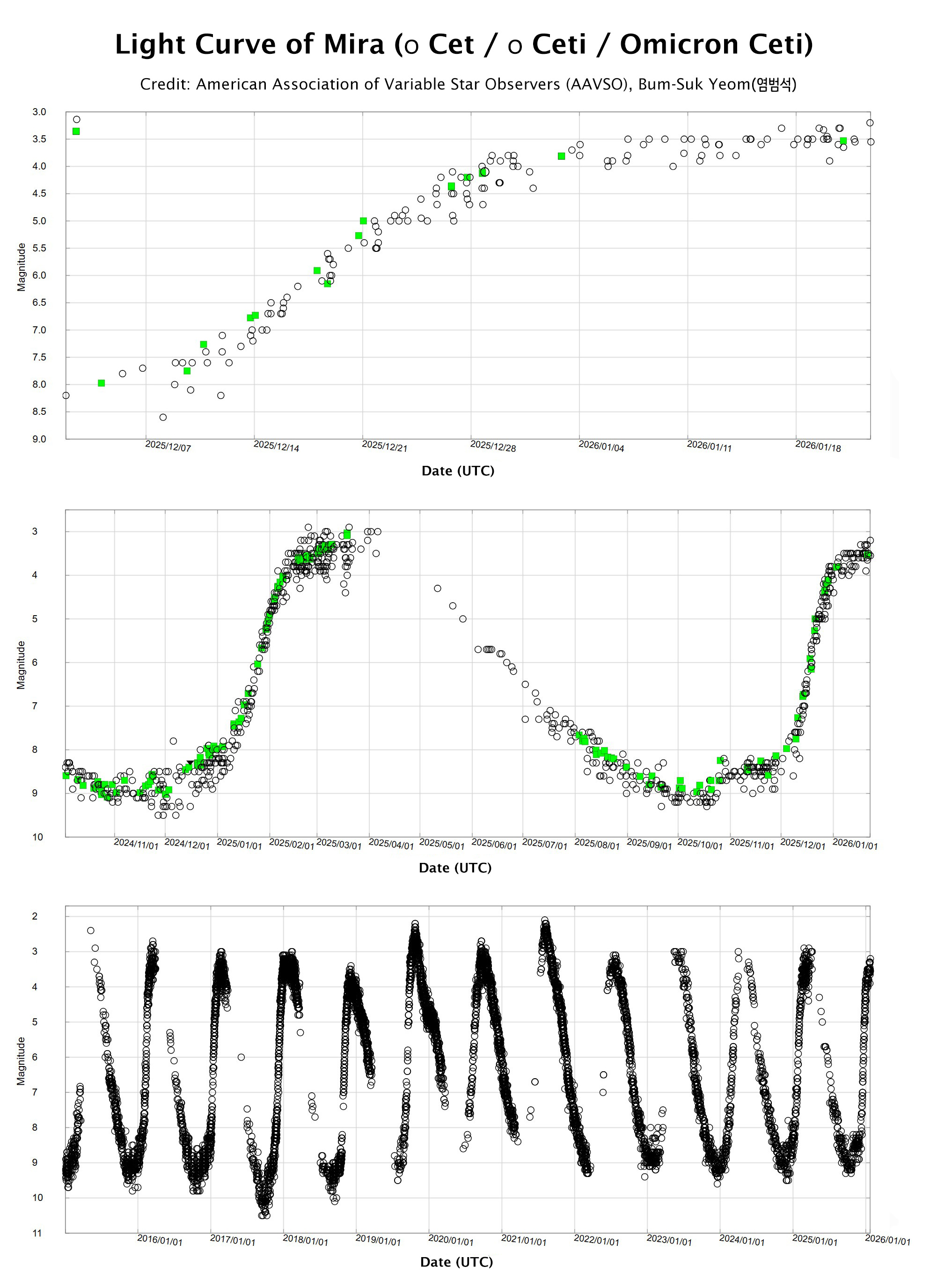
<Light Curves>
https://cometsky.com/astronews/mira_lc_aavso_bsyeom.jpg
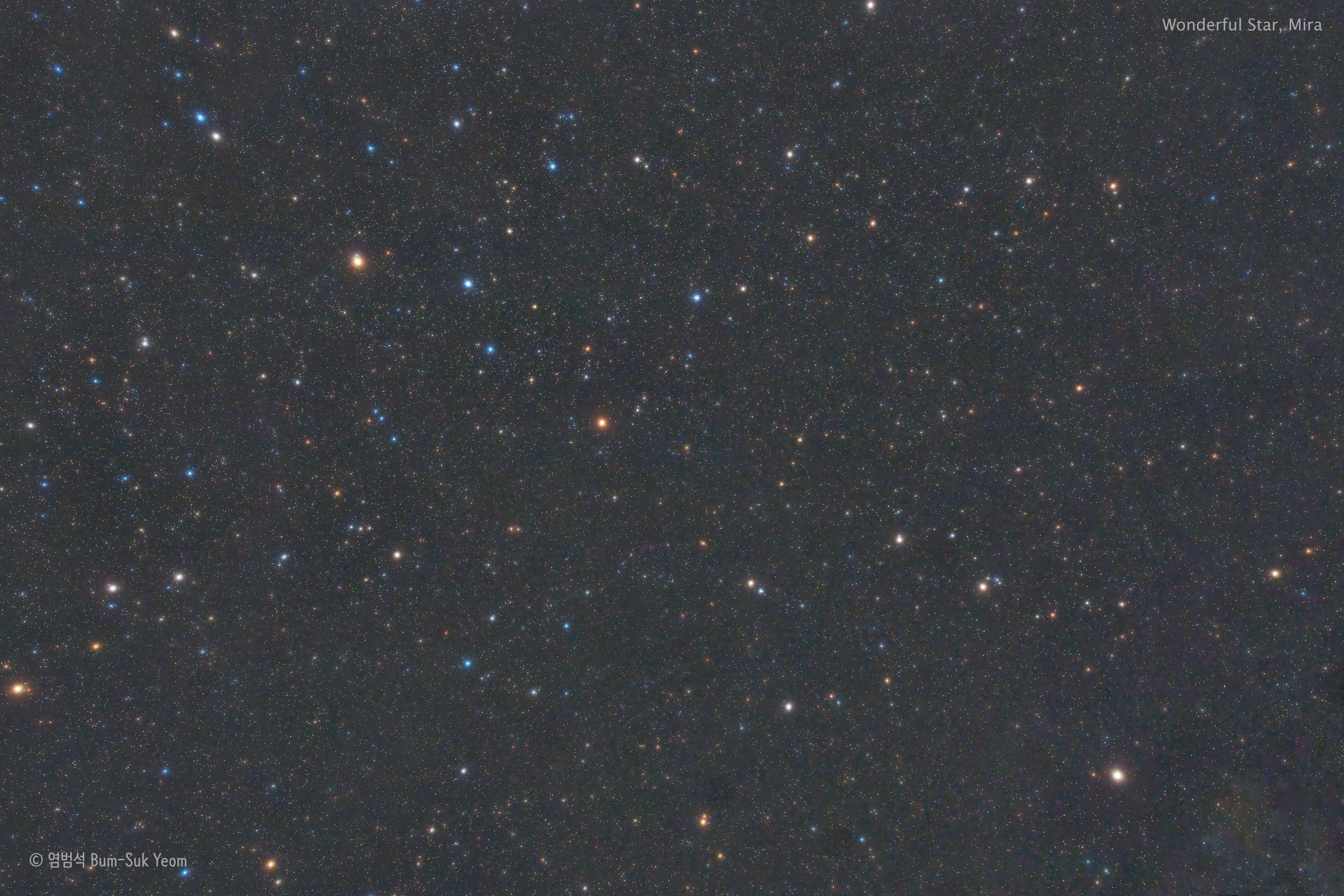
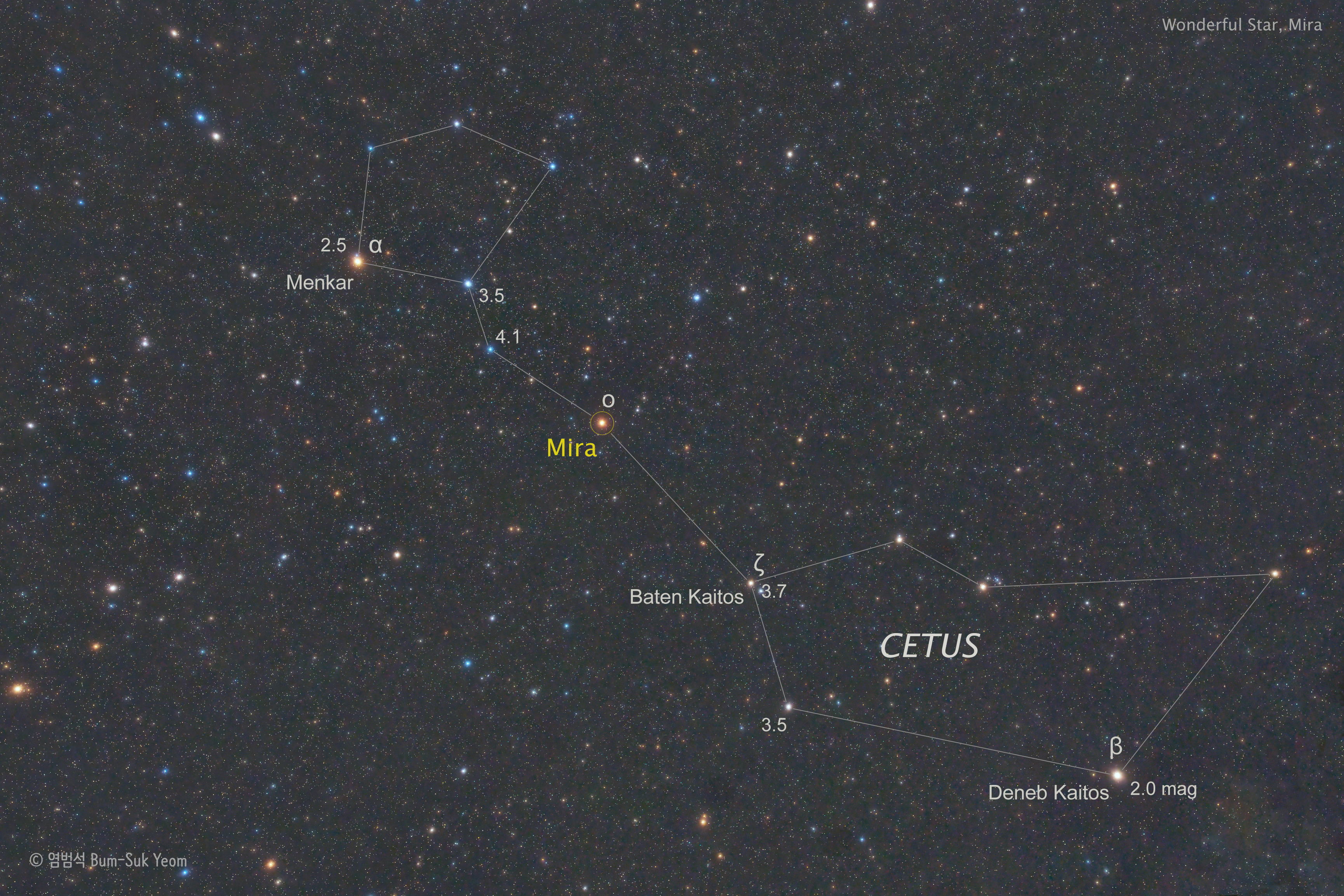
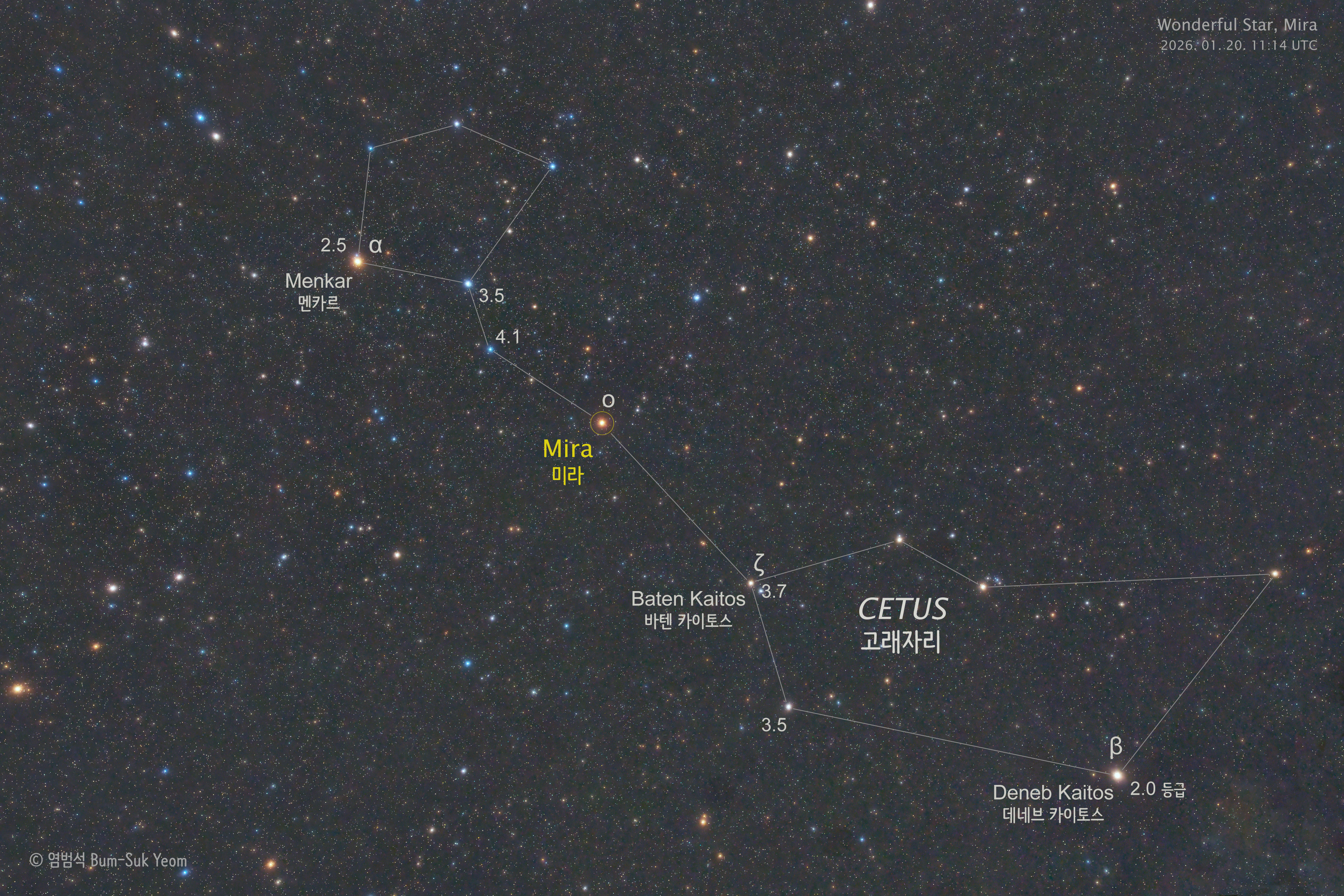
Taken by Bum-Suk Yeom on January 20, 2026 UTC @ Jangsu, South Korea. Details: 11:14 UTC, Sigma Art 28mm F1.4 lens with Sony A7R3 camera, iOptron HAE18C Harmonic mount, 77mm Optolong ClearSky filter, Lee soft #1 filter, f/4, ISO 2500, 60 sec x 20 = 20 min.
2026. 01. 20. 20:14 KST, 시그마 아트 28mm F1.4 렌즈, 소니 A7R3 카메라, 아이옵트론 HAE18C 하모닉 적도의, 77mm 옵토롱 클리어스카이 필터, 리 소프트 1번 필터, f/4, ISO 2500, 노출시간 60초 x 20장 = 20분, 전북특별자치도 장수군, 염범석 Bum-Suk Yeom.
Mira, officially designated as Omicron Ceti (ο Ceti), is one of the most famous variable stars in the constellation Cetus. Its name literally means "The Wonderful." In 1662, Polish astronomer Johannes Hevelius named this star "Mira," meaning "wonderful" or "amazing" in Latin. It's the first pulsating variable star to be discovered. Its light varies across 8 magnitudes over a period of about 332 days. This image was taken from Jangsu, South Korea, on January 20, 2026, during the maximum brightness of the Mira. As of late January 2026, most observers reporting to the American Association of Variable Star Observers (AAVSO) put it around magnitude 3.1 to 3.3. Mira's peak brightness is expected in early February 2026.
< Basic Information >
- Name: Mira (ο Ceti / 68 Ceti)
- Location: Constellation Cetus
- Distance: Approx. 300-400 light-years
- Type: Prototype of Mira-type variable stars (Long-period pulsating)
- System: Binary system (Red Giant 'Mira A' + White Dwarf 'Mira B')
- Variability: It changes brightness from mag 2.0 to 10.1 in a 332-day cycle
- Red Giant (Mira A): An old, pulsating star near the end of its life, losing massive amounts of gas
- White Dwarf Companion (Mira B): A companion star that accretes material from the red giant's winds
- A Star with a Tail: Mira is moving through space at supersonic speed, trailing a 13 light-year-long tail of gas, a phenomenon discovered by Galaxy Evolution Explorer (GALEX).
미라는 고래자리(Cetus)에 위치한 가장 유명한 변광성(Variable Star)으로, "놀라운 별"이라는 뜻의 이름을 가지고 있습니다. 1662년에 폴란드 천문학자인 요하네스 헤벨리우스가 이 별에 라틴어로 "놀라운" 또는 "경이로운"을 의미하는 '미라(Mira)'라는 이름을 붙였습니다. 미라는 최초로 발견된 맥동 변광성입니다. 이 별의 밝기는 약 332일 주기로 8등급에 걸쳐 변화합니다. 이 사진은 미라 변광성의 극대기인 2026년 1월 20일에 대한민국의 장수에서 촬영한 사진입니다. 2026년 1월 말 기준으로 미국 변광성 관측자 협회 (AAVSO)에 보고한 대부분의 관측자들은 미라의 밝기를 3.1~3.3등급으로 보고 있습니다. 미라의 최대 밝기는 2026년 2월 초로 예상합니다.
< 기본 정보 >
- 이름: 미라(Mira), 고래자리 오미크론(Omicron Ceti, ο Cet), 고래자리 68
- 위치: 고래자리
- 거리: 약 200-400광년
- 분류: 장주기 맥동 변광성(Long-period pulsating variable)의 원형(Prototype)
- 구조: 쌍성계 (적색거성 미라 A + 백색왜성 미라 B)
- 밝기 변화: 2등급~10등급, 약 332일 주기. 즉, 맨눈으로 보였다가 사라지는 것처럼 보임
- 적색거성 (Mira A): 태양보다 훨씬 크고, 늙은 별로 수명이 거의 다해가는 상태
- 백색왜성 동반성 (Mira B): 미라 A에서 나오는 가스를 흡수하여 밝게 빛나는 동반성
- 꼬리를 가진 별: 자외선 우주 망원경인 갈렉스가 우주 공간을 빠르게 이동하면서 가스를 내뿜어 형성된 13광년 길이의 꼬리를 발견하였습니다. 이는 일반적인 별에서는 드문 현상.
Bum-Suk Yeom. 염범석.

'Astrophotos > Variable_Stars' 카테고리의 다른 글
| 미라 변광성(Variable star, Mira) (0) | 2013.04.12 |
|---|

댓글